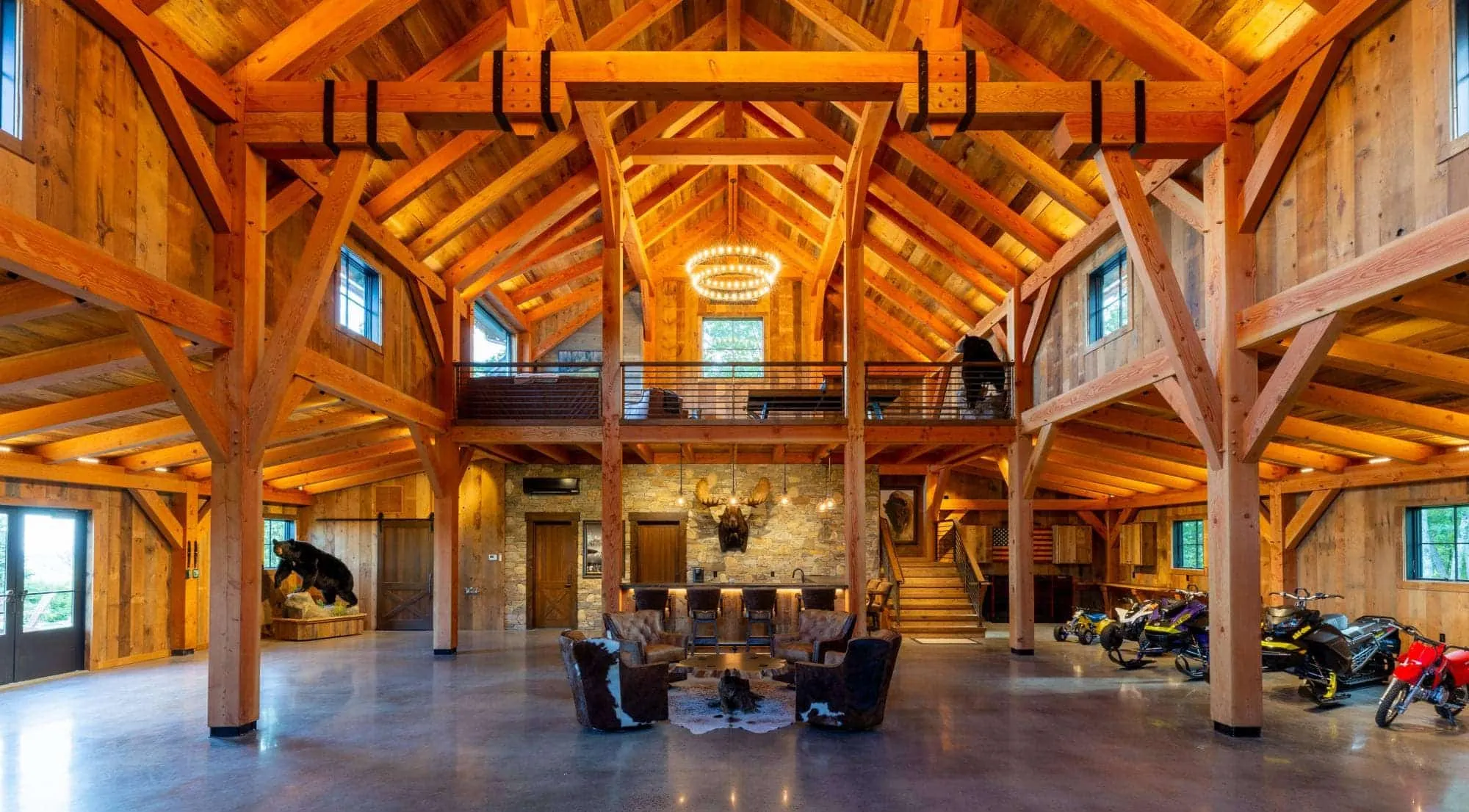
Frederick County is where the Shenandoah Valley opens up — orchard and farm country anchored by Winchester, with estate parcels running from the Blue Ridge foothills in the east to the Allegheny ridges in the west. It is Virginia's northernmost county, and its agricultural landscape and traditional character make it ideal for timber frame construction that respects the region's heritage.
What types of timber frame structures do you build in Frederick County?
Frederick County's farm and orchard landscape and traditional character make it ideal for timber frame construction that respects the region's architectural heritage.
Timber Frame Homes
Primary residences and country homes featuring exposed joinery, balanced massing, and understated detailing suited to Frederick's rural character.
Timber Frame Barns & Agricultural Structures
Horse barns, equipment barns, carriage houses, and multi-use agricultural buildings designed for durability, flexibility, and architectural consistency — including bank barns in the Valley tradition.
Estate Compounds
Thoughtfully planned multi-structure properties that may include a main residence, guest house, barn, garage with living quarters, or pavilion — designed as a cohesive whole.
Legacy Outbuildings
Structures intended to serve families for generations, designed with future adaptability in mind rather than short-term trends.
How much does a timber frame home cost in Frederick County?
Timber frame homes in Frederick County are priced the same way we price them across our four-county service area — by the structure, the site, and the finish level, not by the county line. Turnkey timber frame structures (construction plus builder fee; land, site work, and design excluded) run $450–$750 per square foot, typically $500–$700. All-in — adding design, permits, and site work, land excluded — most projects land at $550–$800 per square foot, with hard sites and ultra-high specifications reaching $800–$1,000+. Complete timber frame homes in our portfolio range from $400K to $10M+ depending on scope. See detailed pricing for a carriage barn or our 5-step design-build process.
Every timber frame home we build is one of one. Custom design-build has no sticker price — two buildings with the same footprint can land far apart once the design, the site, the timber species, and the finish selections are made. The ranges on this page are preliminary planning figures, subject to project-specific design, site conditions, selections, and current market pricing. They exist so you can plan honestly; they are not a quote. The accurate number for your property comes out of the design process — which is exactly what the Feasibility Review is for.
How long does a timber frame project take in Frederick County?
A complete timber frame home in Frederick County typically requires 16–25 months from initial consultation to occupancy.
1
Initial Consultation & Design
3–5 months
2
Permitting (Frederick County)
Varies by project
3
Timber Frame Fabrication
3–4 months
4
Site Work & Foundation
2–3 months
5
Frame Raising & Enclosure
3–4 months
6
Interior Finish
4–7 months
Total typical timeline: 16–25 months for a timber frame home; 10–14 months for a barn or pavilion.
What are the permitting requirements in Frederick County?
Frederick County permitting follows the standard Virginia path — zoning verification, a complete building permit submission, and Health Department approval for well and septic on rural parcels. Complete, accurate submissions move fastest in every county we serve, and Frederick County is no exception.
Key Frederick County Permitting Realities
Zoning: much of rural Frederick County is agricultural — verify your parcel's zoning district, setbacks, and permitted uses before design begins
Rural parcels are served by private well and septic — Health Department soil evaluation and septic approval are part of nearly every project
Agricultural structures: bona fide farm buildings may be treated differently from habitable structures — confirm your building's classification with the county before assuming an exemption
Conservation easements are common on legacy farms — easement terms can set the building envelope and require holder approval before construction
Historic fabric: Winchester and the county's older farmsteads include historic structures — exterior work near them can carry additional review
Long farm driveways: access, turnarounds, and fire-apparatus reach are reviewed as part of site planning
We verify zoning, easements, and Health Department requirements for your specific parcel during the feasibility phase, before design money is spent.
What zoning overlays affect timber frame construction in Frederick County?
Frederick County's zoning is workable on most agricultural parcels, but floodplains along its creeks and recorded conservation easements can significantly impact where a structure can sit. The county's agricultural focus means most rural properties have straightforward zoning — the easement and the building envelope are the constraints to clear first.
What are the common permitting bottlenecks in Frederick County?
The same situations slow projects in every Shenandoah Valley county. Planning for them avoids timeline surprises. Durations vary by project and submission completeness — we confirm the current expectation for your project at consultation.
Zoning Verification
Confirms district, setbacks, and whether your structure is by-right or needs a special use process
Health Department (Septic)
Soil evaluation drives the system design; poor soils require an engineered alternative system and add cost
Building Permit Review
Complete submissions move; incomplete ones go back in the queue — accuracy is the schedule
Conservation Easement Approval
Easement holders review building placement inside the envelope in writing before work starts
Well Permit
Valley limestone yields hard water; plan whole-house treatment from the start
Pro tip: Frederick County rewards the same thing every county in our service area rewards — a complete, well-organized submission. Get the survey, soils, and easement review done before design, not during it.
What site constraints should I plan for in Frederick County?
Frederick County's position at the top of the Shenandoah Valley creates specific site considerations related to geology, water, and rural infrastructure.
Opequon Creek and Back Creek floodplains: properties within FEMA zones require elevation certificates and flood insurance
Limestone geology: karst features and sinkholes require geotechnical investigation; pier foundations are common
Stream buffers and stormwater requirements along the county's creeks affect building envelopes
Long gravel driveways are common: turnaround areas required; base preparation critical for heavy equipment
Rural electric cooperative service: transformer upgrades for large homes can require extended lead time — verify capacity early
Well water quality: limestone aquifers produce hard water; whole-house filtration is typically required
Equipment access: historic farm lanes and older bridges may not accommodate modern crane weights — delivery planning is essential
Early site evaluation — including soil testing, well capacity, and infrastructure assessment — ensures accurate budgeting and prevents construction delays.
What mistakes should I avoid with timber frame construction in Frederick County?
Here are the mistakes we help Frederick County clients avoid:
Underestimating limestone foundation requirements
Frederick County sits on Shenandoah Valley limestone. Some sites require blasting or specialized foundations. A geotechnical survey before design prevents costly surprises.
Overlooking creek floodplain restrictions
Properties near Opequon Creek, Back Creek, and their tributaries face floodplain regulations that can restrict building envelopes and require elevated construction. Verify flood zone status before committing to a property or design.
Assuming adequate rural power infrastructure
Remote Frederick County properties may have inadequate power capacity for modern homes. Transformer upgrades and line extensions add real cost. Verify utility capacity early.
Skipping well water testing
Frederick County well water quality varies significantly, and limestone aquifers produce hard, mineral-heavy water. Test water quality and quantity before finalizing your site plan — treatment systems affect budget and mechanical room planning.
Our initial consultation includes utility assessment, soil evaluation, and review of any recorded easements to ensure your project starts on solid ground.
Where We Build in Frederick County
Our work spans Frederick County's agricultural communities:
Winchester
Stephens City
Middletown
Cross Junction
Gore
Frederick is Virginia's northernmost county — we work throughout its boundaries on properties suited to timber frame construction.
See Our Frederick County Work
Browse timber frame work from across our four-county service area — Loudoun, Fauquier, Clarke, and Frederick.
Ready to discuss a timber frame home, barn, or estate structure in Frederick County? We begin with a complimentary consultation to understand your land and vision.
Timber frame homes, barns, and estate structures in Frederick County, VA — Winchester, Stephens City, Middletown, Cross Junction, and Gore. One design-build team from the first walk of the land to the finished estate.
Frederick County, Virginia
Frederick County is where the Shenandoah Valley opens up — orchard and farm country anchored by Winchester, with estate parcels running from the Blue Ridge foothills in the east to the Allegheny ridges in the west. It is Virginia's northernmost county, and its agricultural landscape and traditional character make it ideal for timber frame construction that respects the region's heritage.
Hearthstone Design Build — Custom Timber Frame Home Builder, Northern Virginia
Hearthstone Design Build is a licensed Class A custom timber frame home builder and design-build firm based in Leesburg, Virginia. We design, engineer, permit, and construct timber frame homes, carriage barns, pavilions, and estate outdoor living across Loudoun, Fauquier, and Clarke counties.