Related Hearthstone Projects
Written by Dan Caporale, Principal — USMC Veteran, VA Class A Contractor License #2705195817.
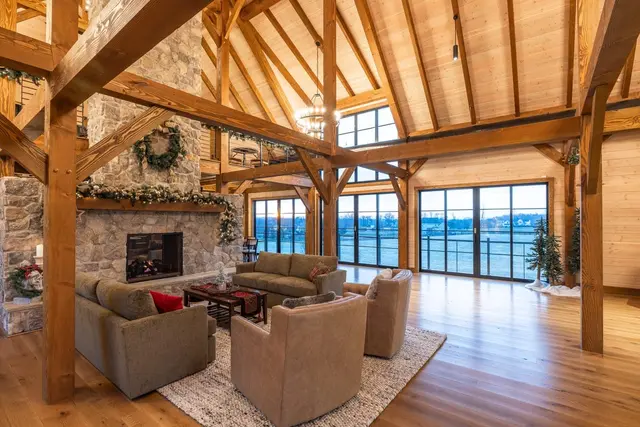
The species you pick sets the frame package price three-fold apart: $12–$18/sq ft for Eastern White Pine, $16–$24 for Douglas Fir, $25–$40+ for White Oak. It also dictates your spans, member sizes, and lead time, which is why it has to be chosen before the structural engineer touches the drawings. ## Which timber frame species is best for a Virginia home? Three species dominate Virginia timber frame: Eastern White Pine ($12–$18/sq ft frame package), the regional standard good for 16–24-foot spans; Douglas Fir ($16–$24/sq ft) for 30+ foot clear spans and a refined grain; and White Oak ($25–$40+/sq ft), the heritage specification. Select species before structural engineering begins. ## The Decision That Defines the Home Every major decision in a custom home has consequences that play out across time. The species selection in a timber frame home is one of the most consequential because it determines the visual and tactile experience of the home from move-in day until the structure outlasts its first owners -- which, in a properly built timber frame, it will. The choice is not primarily aesthetic, though aesthetics matter. It is structural, performative, and operational. The species determines the allowable spans, the member sizes required to achieve those spans, the weight of the frame, the fabrication timeline, the long-term moisture behavior, and the cost of the frame package. Most owners make this decision based on visual preference from photographs. The right way to make it is to visit completed projects built with each species, spend time in the spaces, and understand the structural and operational tradeoffs before committing. ## Eastern White Pine: Virginia's Native Timber Eastern White Pine (Pinus strobus) is the most widely used timber frame species in Virginia and the Mid-Atlantic. It grows throughout the Appalachian region and has been the primary building material for Virginia's agricultural and residential structures since the colonial period. The oldest surviving timber frame buildings in Virginia were built with Eastern White Pine. ### Visual Character Eastern White Pine has a warm golden-yellow tone that deepens to amber over time. The grain is relatively even, with occasional character knots and subtle variation. Freshly sawn Pine has a bright, clean appearance. After 10-20 years, it develops a warm patina that becomes the signature look of a lived-in timber frame home. Pine is the warmer, more familiar choice. It reads as the quintessential American timber frame. ### Structural Performance Eastern White Pine has a specific gravity of approximately 0.35 and a modulus of elasticity of 1,200,000 psi. This is a lower structural value than Douglas Fir or White Oak. For standard residential spans -- 16-24 feet clear -- Eastern White Pine performs adequately with appropriately sized members. For longer spans (30+ feet) or for structures carrying heavy loads (horse barns, large trusses), Douglas Fir or White Oak is typically the better choice. In practical terms: Eastern White Pine members are larger in cross-section than Douglas Fir members carrying the same load over the same span. A 10x12 Pine purlin does what an 8x10 Fir purlin does. The visual difference -- slightly heavier members -- is part of the Pine aesthetic. It reads as robust rather than refined. ### Moisture Behavior Eastern White Pine is dimensionally stable once dried but is more susceptible to surface checking (small surface cracks) during initial drying than Fir or Oak. Checking is a normal, expected characteristic of heavy timber and does not affect structural integrity. It is visible evidence that the wood is alive and responding to its environment. ### Sourcing and Cost Eastern White Pine is sourced regionally -- from Virginia, West Virginia, and New England -- and is the most readily available species for Virginia timber frame projects. The shorter supply chain reduces both cost and lead time. **Frame package cost (frame only, not including erection):** $12-$18 per square foot of building area. --- ## Douglas Fir: The Structural Premium Douglas Fir (Pseudotsuga menziesii) comes from the Pacific Northwest and is the structural workhorse of American timber frame construction. It is denser, stronger, and more dimensionally stable than Eastern White Pine, and it delivers a more refined visual character. ### Visual Character Douglas Fir has a rich amber-orange tone with a tight, complex grain pattern that becomes more pronounced with age. The vertical grain of select-grade Douglas Fir is one of the most visually striking materials available in timber frame construction -- the grain lines run parallel and close together, creating a precision and depth that Pine cannot replicate. Douglas Fir reads as more refined and less rustic than Eastern White Pine. It is the appropriate choice for homes where a more tailored aesthetic is intended -- where the timber frame should read as architecture rather than heritage vernacular. ### Structural Performance Douglas Fir has a specific gravity of approximately 0.50 and a modulus of elasticity of 1,900,000 psi -- significantly stiffer and stronger than Eastern White Pine. This structural advantage translates directly into member size efficiency: Douglas Fir achieves the same spans with smaller cross-sections, or achieves longer spans with the same cross-sections. For long-span applications -- great rooms with 30-40 foot clear spans, equestrian facilities, event structures -- Douglas Fir is the standard choice. It also performs better in wet environments (production spaces, outdoor structures with weather exposure) due to its higher density and natural resin content. ### Sourcing and Cost Douglas Fir is sourced from the Pacific Northwest, which extends the supply chain and adds to lead time compared to regional Pine. The longer sourcing distance and higher structural value both contribute to a cost premium. **Frame package cost:** $16-$24 per square foot of building area. ### When Douglas Fir Is the Right Choice - Long spans (30+ feet clear) - Production or hospitality spaces where moisture exposure is a concern - Homes where a more refined, architecturally precise visual character is the design intention - Structures carrying heavy loads (large barns, equestrian facilities) - Budget allows the premium --- ## White Oak: The Heritage Specification White Oak (Quercus alba) is the premium choice for Virginia timber frame homes where material quality and heritage character are the defining priorities. It is the species used in Virginia's finest historical structures, and it remains the specification for projects where nothing else will do. ### Visual Character White Oak has a warm, golden-brown tone with a distinctive ray figure (the medullary rays that create a pattern visible in quarter-sawn sections) and a rich, complex grain. It is the most architecturally sophisticated of the three species -- the material that reads as permanent, authoritative, and settled. Quarter-sawn White Oak, where the grain runs perpendicular to the face of the member, is the premium specification. The ray figure creates a visual depth that no other species can replicate. ### Structural Performance White Oak has a specific gravity of approximately 0.68 -- nearly twice that of Eastern White Pine. This density translates into exceptional structural performance, hardness, and resistance to wear. It is the material for joinery that will last 200 years without movement or deterioration. The weight of White Oak is also its primary construction challenge: a large White Oak bent weighs substantially more than a Pine or Fir bent of equivalent dimensions, requiring crane capacity calculations and erection planning that reflect the added mass. ### Cost and Availability White Oak is harvested domestically and is available from specialty timber frame shops that can select and dry appropriate timber. The material cost premium over Eastern White Pine is 2-3x, and the added weight increases erection costs. **Frame package cost:** $25-$40+ per square foot of building area. ### When White Oak Is the Right Choice - Projects where material heritage and permanence are the primary values - Owners for whom cost is not the primary constraint - Structures where joinery will be visually prominent and examined closely (significant entry elements, a pavilion with close human scale) - Historic or traditional architectural programs where White Oak is the authentic material --- ## The Comparative Summary | Factor | Eastern White Pine | Douglas Fir | White Oak | |--------|-------------------|-------------|-----------| | Visual character | Warm, rustic, American | Refined, architectural | Heritage, authoritative | | Structural capacity | Good (standard spans) | Excellent (long spans) | Exceptional | | Moisture resistance | Adequate | Good | Excellent | | Member size efficiency | Larger sections required | Efficient | Most efficient | | Regional sourcing | Yes (Virginia/Appalachia) | No (Pacific NW) | Yes (domestic) | | Lead time | Shortest | Moderate | Longest | | Frame cost | $12-$18/sqft | $16-$24/sqft | $25-$40+/sqft | | Best for | Most Virginia estates | Long spans, production | Premium landmark projects | --- ## FAQ **Q: Can I mix species within one timber frame home?** Yes, and it is often the most cost-effective approach. Structural bents (the primary frames that carry the major loads) are commonly Douglas Fir for efficiency and capacity, while secondary framing (purlins, plates, braces) uses Eastern White Pine at lower cost. The species mixing is visible to those who look closely but reads as cohesive in the overall structure. Discuss the mixing strategy with the structural engineer and frame shop during the design phase. **Q: Does the species choice affect the building permit process?** The structural engineering calculations must reflect the actual species and grade selected, as different species have different structural values. The engineer specifies the species and grade in the structural drawings. A change in species after engineering is complete requires an engineering revision. Select the species before structural engineering begins. **Q: How does the timber frame species relate to resale value?** Douglas Fir and White Oak timber frames are consistently associated with higher appraised values in Loudoun County's equestrian estate market than Eastern White Pine, reflecting both the material cost and the visual refinement. Eastern White Pine frames are well-regarded and market successfully -- they simply do not command the same premium. The choice should be made on program, aesthetic, and budget grounds; let the resale premium be a secondary consideration. --- *Selecting species for your timber frame home? Let's make the decision together in preconstruction: hearthstonedesignbuild.com/contact | (571) 556-1900*Keep reading
- What is timber frame construction? — the framing system your species choice is going into.
- Timber frame homes in Loudoun County — how species, joinery, and enclosure interact on a full custom estate build.
- Timber frame vs. conventional framing in Virginia — where the structural, aesthetic, and cost differences actually show up.