Related Hearthstone Projects
Written by Dan Caporale, Principal — USMC Veteran, VA Class A Contractor License #2705195817.
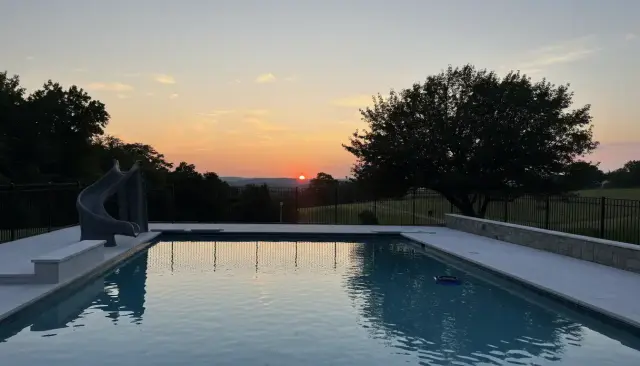
On a rural Northern Virginia estate, the shell is the cheap part: site prep, drainage, water infrastructure, and structural support run 40–60% of the total, which is why a planned "$150,000 pool" lands at $300,000–$500,000 once the well yield and holding tank are solved. ## What does it cost to build a pool on rural land in Northern Virginia? A complete estate pool on rural Northern Virginia land runs $200,000–$500,000+, or $350,000–$800,000+ with a pool house and full hardscape. Site work, water infrastructure, drainage, and structural support account for 40–60% of total cost. On well-served parcels, well yield and a 5,000–10,000-gallon holding tank must be solved first. ## The Project Behind the Pool A pool project on a rural estate in Northern Virginia is a significant civil engineering undertaking that happens to produce a pool as its output. Understanding this framing is the most important orientation for any estate owner planning a pool. The pool itself -- the shell, the equipment, the finish -- is typically the smaller portion of the total investment. The site preparation, water infrastructure, drainage management, structural support on sloped sites, and integration with the estate's existing infrastructure typically represents 40-60% of the total project cost. Owners who plan for the pool and discover the site costs mid-project face difficult choices. Owners who plan for the full scope from the beginning execute the project correctly. ## Water Source: The Question That Must Come First A pool on rural land requires water to fill it (typically 20,000-40,000 gallons), water to top it off regularly (evaporation and splash-out), and water for backwashing the filtration system. On a property served by a municipal water system, this is a billing issue, not an engineering one. On a well-served rural property, it is an engineering question with significant implications. **Well yield assessment:** A standard residential well permit in Virginia is based on a yield of one gallon per minute -- adequate for a household but not for filling or regularly topping off a pool. Before committing to a pool on a rural property, have the well tested for yield at the current pump rate. If the well cannot sustain the demand required for pool operations without drawing down below acceptable levels, the options are: - A larger-capacity well (requires a new permit and additional drilling) - A holding tank that accumulates well water over time for pool top-off - A rainwater collection system for pool top-off only - A separate commercial well permit (required if the well will serve non-residential demand at commercial scale) For estate pools on rural properties, a holding tank combined with the existing well is the most common solution. The tank is sized to store 5,000-10,000 gallons and replenishes continuously from the well between pool fill-up events. ## Site Preparation and Drainage **Site selection:** The pool should be sited on reasonably level ground or cut into a hillside with engineered retaining walls. On sloped Virginia estate sites, the most dramatic pool placements -- perched at a grade break with views over the landscape -- require the most engineered structural support and are the most expensive to construct. **Cut and fill:** On any site with more than a few feet of grade change within the pool envelope, significant earthwork is required. Rock encountered during excavation (common in western Loudoun County's limestone-rich soils) can double earthwork costs. **Drainage:** Pool decks must drain positively away from the pool and toward a collection system that can handle the volume during heavy rain events. Pool water (whether from backwash, splash-out, or drainage) must be routed to an appropriate disposal point -- not to a septic drain field. A dedicated drip line or drywell is typically required. **Hardscape integration:** The pool deck, pool house or shade structure, and landscape integration are the elements that determine whether the pool reads as an estate amenity or a construction afterthought. Budget for the full hardscape scope before committing to the pool. ## Permit Requirements **Loudoun County building permit:** A pool is a permitted structure in Loudoun County. The permit application requires a site plan showing the pool location relative to property lines, structures, and setbacks; the pool shell design and equipment specifications; and an electrical plan. **Setback requirements:** In Loudoun County's AR-1 district, pools must maintain minimum setbacks from property lines (typically 10-15 feet), from structures, and from septic system components. In most cases, a pool setback from the septic drain field of at least 50-100 feet is required -- a constraint that can significantly limit pool placement on smaller parcels. **Electrical permit:** Pool electrical systems -- pump motors, lighting, heating equipment -- require a separate electrical permit and inspection. **Health and safety requirements:** Loudoun County requires a barrier (fence, wall, or equivalent) meeting specific height and gate requirements around residential swimming pools. This requirement applies to all pools, including those on rural estate properties. ## Pool Types for Virginia Estates **Gunite/shotcrete:** The standard for estate pools in Northern Virginia. A steel reinforcement cage is formed in the excavated hole, and concrete is pneumatically applied (gunite) or pumped (shotcrete) over the reinforcement. The result is a fully customizable shell of any shape, depth, or configuration. Finish options range from plaster to tile to aggregate. **Vinyl liner:** Lower initial cost than gunite but with a liner lifespan of 10-15 years before replacement is required. Appropriate for budget-constrained projects; not the specification for estate properties. **Fiberglass:** Pre-manufactured shells that are delivered and set into the excavated hole. Limited to standard manufactured shapes. Faster installation than gunite but with shape and size limitations that do not suit most estate programs. For Virginia estate construction, gunite is the specification. The investment in a properly engineered shell with quality finishes lasts 30+ years with appropriate maintenance. ## Cost Framework On a typical rural estate property in Northern Virginia, a complete pool project scope includes: | Component | Range | |-----------|-------| | Site preparation (excavation, grading, drainage) | $20,000 -- $60,000+ | | Gunite shell (including steel, finish, skimmers) | $80,000 -- $150,000+ | | Mechanical equipment (pump, filter, heater, automation) | $15,000 -- $35,000 | | Electrical (panel, wiring, lighting, bonding) | $10,000 -- $25,000 | | Pool deck hardscape | $30,000 -- $100,000+ | | Fence and safety barrier | $8,000 -- $25,000 | | Water source (holding tank, well modification) | $5,000 -- $30,000 | | Landscape integration | $15,000 -- $60,000+ | | Pool house / shade structure | $50,000 -- $200,000+ | | **Total typical estate pool (no pool house)** | **$200,000 -- $500,000+** | | **Total with pool house and full hardscape** | **$350,000 -- $800,000+** | The estate pool project that Dan and Sarah planned as a "$150,000 pool" typically costs $300,000-$500,000 on a rural Virginia site when all site costs, hardscape, infrastructure, and equipment are accounted for. ## The Design-Build Advantage for Pool Projects Pool construction on rural estates involves coordination between the pool contractor, civil engineer (site work, drainage), electrician, landscape contractor, and in many cases a structural engineer (retaining walls, pool house). This coordination is a project management problem that falls entirely on the owner in a traditional delivery arrangement. In a design-build engagement where the pool is part of a broader estate project, Hearthstone manages this coordination as part of the overall project. The pool siting, drainage, and infrastructure are integrated with the master site plan from the beginning rather than being added as a separate project with its own sequencing challenges. --- ## FAQ **Q: Can I build a pool on a property that only has a well?** Yes, but the well must have adequate yield and the water demand must be managed carefully. For a standard estate pool (30,000-35,000 gallon fill), a holding tank that accumulates well water over several weeks before a major fill event is the standard solution. For ongoing top-off (200-500 gallons per week in summer), most residential wells in Loudoun County can accommodate this demand without modification. **Q: How far does a pool need to be from the septic system on rural land?** Virginia regulations require a minimum 50-foot setback from a swimming pool to any part of a septic system (tank, distribution box, or drain field). Loudoun County may apply additional setback requirements. On smaller rural parcels where the septic system occupies a significant portion of the building envelope, this setback can limit pool placement significantly. **Q: How long does a pool project take from start to completion?** From permit application through final inspection on a rural estate site: typically 6-12 months. Site preparation and foundation work take 2-3 months. Gunite and finish work take 1-2 months. Electrical, mechanical, and hardscape complete the project over 2-4 months. Permitting adds 2-3 months to the front end. Start the project planning 12-18 months before your intended swim season. --- *Planning a pool for your Northern Virginia estate? Site the project correctly from the beginning: hearthstonedesignbuild.com/contact | (571) 556-1900*Keep reading
- Pools & hardscaping service overview — how we scope and price the full pool + hardscape scope under one design-build contract.
- Estate pools in Loudoun County — vanishing edge, perimeter overflow, and spa-integrated builds on hillside parcels.
- Septic and well planning on rural Virginia land — the water-supply and drainfield realities that dictate where a pool can go.
- Estate pool cost and permitting in Loudoun — the $175K–$450K+ range and Health Department timelines.